
Whoa!
I first opened a Solana block and felt a little dizzy. The raw numbers hit you fast. My instinct said “this will be simple,” but actually the ecosystem is layered and messy, and that complexity is the thing that’s both exciting and frustrating. I’m biased, sure—I’ve chased transaction traces at 3 a.m.—so take that for what it’s worth.
Really?
Yes — Solana’s throughput looks like a racetrack. On one hand its speed gives you a lot of signal to inspect; though actually that same speed can hide important patterns if you don’t filter smartly. Initially I thought raw TPS was the story, but then I realized that meaningful analytics are about relationships: account behavior over time, cohort flows, and abnormal spikes that suggest front-running, bot swarms, or contract bugs.
Hmm…
Here’s the thing. The native Solana explorer is reliable and straightforward for basic block/tx lookups, and it’s maintained by the network people who know the ledger intimately. It’s good for sanity checks — hashes, confirmations, program IDs — and it gives you canonical data without third-party aggregation biases. But when you want deeper context, historical charts, token flow visualization, or consolidated wallet lookups, you often reach for tools built with analytics-first thinking.
Whoa!
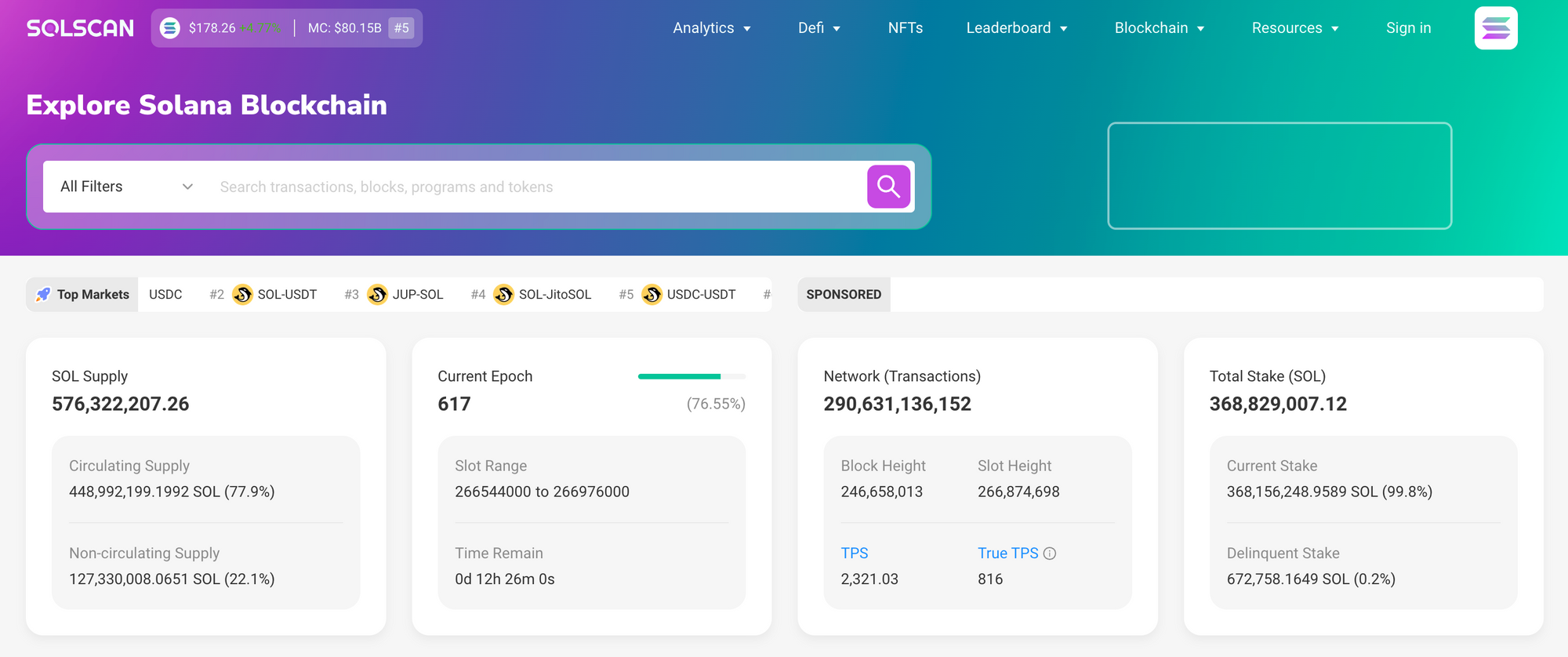
I’m talking about dashboards that stitch together events across slots and programs, and that let you pivot quickly from a wallet to every associated token mint. Solscan provides that layer in a crisp UI, and I’ve used it to spot patterns that would be invisible in the native explorer alone. Check this out—if you prefer a single place with readable charts and filters, try solscan for a hands-on feel.
Really?
Yes, again. But wait—let me rephrase that: neither tool is objectively better for every job. The native explorer gives you a ground-truth ledger view, and third-party explorers add derived metrics and UX polish that matter to humans. On the technical side, beware of indexing lag, cached snapshots, and how token metadata is resolved; different services reconcile these things differently, and that affects what you read.
Whoa!
On practical analytics: start small. Track a handful of wallets or tokens you actually care about and set a baseline for “normal” activity. Then hunt for anomalies — sudden balance changes, repeated tiny transfers, clustered trades around a slot window. My instinct said to scan for obvious signs like high-frequency micro-transfers, and that often points to bots or gas-fee gaming (on Solana it’s different, but patterns remain).
Hmm…
For developers, here’s a layered approach I use: first confirm the on-chain event with the native explorer, then pull up consolidated timelines and token flows on an analytics explorer to understand the context. Initially I thought a single view would answer everything; actually, you need both canonical proof and human-friendly aggregation to form a confident hypothesis about behavior. This method reduces false positives from noisy data and gives you a defensible read when reporting bugs or suspect activity.
Really?
Yep. For research and audits, exportability matters. If you can CSV-export transaction lists, annotated logs, or token flow graphs, you can run custom models or hand-check edge cases. Some explorers hide raw logs behind proprietary visualizations; others give you endpoint-level access. Decide which trade-offs you accept depending on whether you prioritize reproducibility or speed of insight.
Whoa!
One practical caution: token metadata and name squatting issues on Solana can mislead you. A token labeled “USD” in a UI might be a scam mint if you don’t validate the mint address. My gut said “trust the label,” and I got fooled once. So validate program IDs, check verified collections, and don’t assume readable names equal legitimacy.
Hmm…
On tooling: pair explorers with on-chain alerting and local rule sets. Don’t rely on a single dashboard for high-stakes decisions. I run simple heuristics locally — big transfers to new wallets, sudden increases in delegation, or repeated contract calls — and then use the explorer to visually confirm. This reduces noise and helps prioritize when things require manual attention.
Practical tips and quick checklist
Okay, so check this out—make a small checklist you actually use. First, verify the mint address and program ID. Second, cross-reference with a canonical source (the native explorer) to confirm block and slot data. Third, use an analytics explorer for historical trends and token flows (visual patterns often reveal bot strategies or liquidity shifts). Fourth, export and archive any suspicious tx lists for later review; chain state changes fast, and you’ll want a snapshot. Finally, remember that UX can obscure details — zoom into raw logs when in doubt.
Whoa!
I’ll be honest: sometimes the best insight comes from pattern recognition rather than fancy models. Watching a few wallets over weeks reveals the story faster than a blind statistical test. I am not 100% sure why our brains are wired that way, but humans excel at narratives and spotting outliers visually. So use that strength alongside quantitative checks.
Really?
Absolutely. There’s a community factor too — Discords, audit reports, and quick crowdsourced observations often accelerate detection, though they also introduce bias and noise. When you combine community observations with ledger-backed proof, you’re in a strong position to call something suspicious or noteworthy.
FAQ
Which explorer should I use for deep dives: the native Solana explorer or a third-party like solscan?
Use both. The native explorer is your ground truth for raw ledger data. Third-party explorers like solscan layer on history, filters, and UX that speed up pattern discovery. Start with the native view to confirm hashes and slots, then use analytics UIs for context, charts, and token flows. Export findings when possible and always validate mint and program IDs before trusting readable labels.